
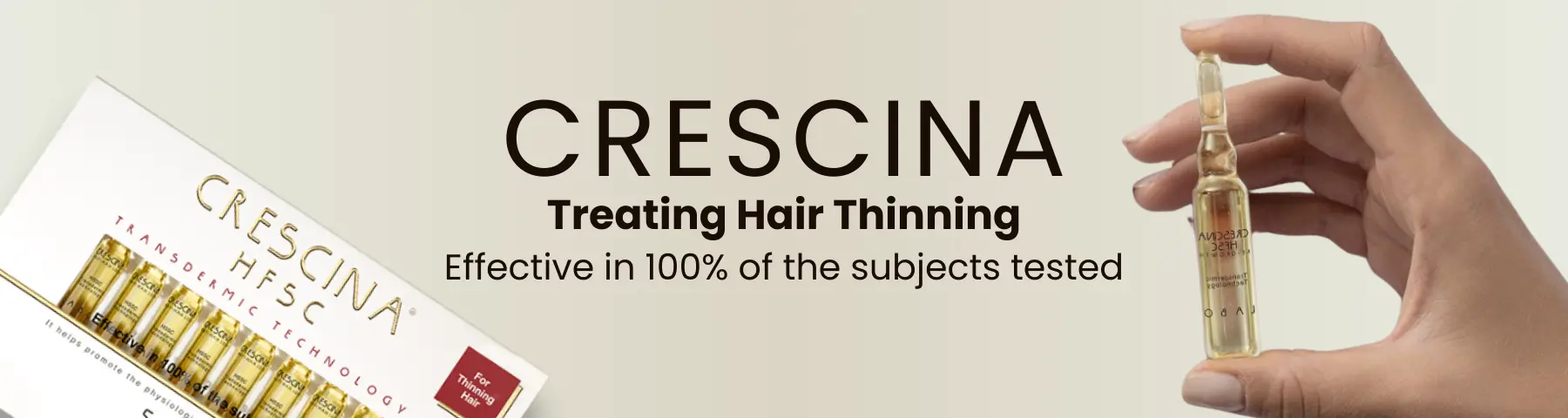
Hair thinning and loss can impact confidence, prompting many to seek effective solutions. Two popular options are Crescina, a Swiss dermo-cosmetic treatment, and Minoxidil, a well-known FDA-approved medication. While both aim to combat hair loss and promote regrowth, they differ significantly in their approach, ingredients, and application. This article compares Crescina and Minoxidil to help you decide which is best for your needs. Explore Crescina’s innovative range at Swiss Origin and take the first step toward healthier hair.
Understanding Crescina and Minoxidil
Crescina: Swiss Dermo-Cosmetic Innovation
Crescina, developed by Labo Suisse, is a topical dermo-cosmetic treatment designed to address physiological (non-pathological) hair thinning, such as androgenetic alopecia (AGA). It uses Transdermic Technology (Swiss Patent CH 711 466) to deliver active ingredients like Cysteine, Lysine, Glycoprotein, and Stem-Engine directly to hair follicles, promoting regrowth and reducing hair loss. Available in grades (200, 500, 1300, 1900, 2100) for varying thinning severity, Crescina offers formulations for men and women, targeting single follicles and Hair Follicular Islands (complex structures comprising 60-70% of scalp hair). Shop Crescina at Swiss Origin.
Minoxidil: FDA-Approved Pharmaceutical
Minoxidil, commonly sold as Rogaine, is a topical (2% or 5%) or oral (off-label, 0.5-5 mg/day) medication FDA-approved for AGA in men and women. Originally developed for hypertension, it promotes hair growth as a vasodilator, increasing blood flow to follicles, and acts through multiple pathways, including anti-inflammatory and anti-androgenic effects. Available over-the-counter (topical) or by prescription (oral or higher-strength topical), Minoxidil requires continuous use to maintain results.
How They Work
Crescina’s Mechanism
Crescina’s multi-complex formula targets three key areas:
- Stem Cell Activation: The HFSC Complex (Hydrolyzed Rice Protein, Corosolic Acid) stimulates follicle stem cells to encourage regrowth.
- Keratinization: Cysteine, Lysine, and Glycoprotein support hair shaft formation.
- Microcirculation: Benzyl Nicotinate, a mild vasodilator, enhances scalp blood flow.
Its Transdermic Technology ensures deep penetration without injections, offering a non-invasive alternative to mesotherapy or PRP. Crescina is ideal for early to moderate thinning but ineffective on fully atrophied follicles.
Minoxidil’s Mechanism
Minoxidil primarily works as a vasodilator, widening scalp blood vessels to deliver nutrients to follicles, extending the anagen (growth) phase. It also activates potassium channels and may reduce DHT sensitivity, though its anti-androgenic effects are weaker than finasteride. Topical Minoxidil (5%) is more effective than 2% for men, with 45% more regrowth at 48 weeks, but requires consistent application. Oral Minoxidil, used off-label, may benefit those with low follicular sulfotransferase activity.
Efficacy Comparison
Crescina’s Clinical Results
A 2013 placebo-controlled study on men with AGA (grades II-IV) found Crescina HFSC increased the anagen rate by 6.8% after 2 months and 10.7% after 4 months, with hair loss reduced by 29.6% and 46.8% (pull test). All subjects showed new hair growth by 4 months, averaging +7 to +41 hairs in a 1.8 cm² area. These results suggest Crescina is effective for physiological thinning, particularly in early stages.
Minoxidil’s Clinical Results
Minoxidil’s efficacy is well-documented. A 48-week study showed 5% topical Minoxidil increased hair count by 45% more than 2% in men with AGA. A one-year observational study reported 62% of men experienced reduced hair loss, with 64% rating it “very effective” or “effective” for regrowth. Oral Minoxidil (5 mg/day) outperformed topical versions in some studies, with 43% of men showing excellent results. However, efficacy varies by individual, and results plateau after 12-16 weeks.
Head-to-Head
- Crescina: Best for early to moderate thinning, with a 100% response rate in clinical trials for new hair growth. Its non-pharmacological nature appeals to those avoiding drugs.
- Minoxidil: More effective for broader AGA cases, including advanced stages, but requires lifelong use, as regrowth reverses within 3 months of discontinuation.
Side Effects and Safety
Crescina
Crescina is generally well-tolerated, with no systemic side effects due to its cosmetic nature. The mild vasodilator (Benzyl Nicotinate) may cause temporary scalp redness or warmth, which subsides quickly. It’s safe for most users, including during pregnancy (with doctor consultation), and has no reported interactions with other treatments.
Minoxidil
Topical Minoxidil may cause scalp irritation, itching, flaking, or unwanted facial hair growth. Higher concentrations (e.g., 10%) increase side effects without superior efficacy. Oral Minoxidil, used off-label, can cause dizziness, excessive hair growth elsewhere, or rare cardiovascular effects. Initial shedding (telogen effluvium) may occur in the first 2-4 weeks. Consult a dermatologist before use, especially for oral forms.
Application and Convenience
Crescina
Crescina is applied via 3.5 ml vials (1 ml for mild thinning) on a clean, dry scalp, 5 days on, 2 days off, for 2-4 months. A 20-vial box (1-3 months’ supply) costs €127-€283. It dries quickly, is non-greasy, and pairs well with Crescina Shampoo. Users can combine it with Minoxidil, applying Crescina 20 minutes before to avoid interference. Shop Crescina at Swiss Origin.
Minoxidil
Topical Minoxidil (2% or 5%) is applied twice daily, requiring 2-4 hours to dry fully, which may stain bedding if applied before bed. Oral Minoxidil is taken once daily but requires a prescription. Costs vary (€20-€50/month for topical). Discontinuation leads to loss of regrowth within 3 months, demanding long-term commitment.
Which Should You Choose?
Choose Crescina If:
- You have early to moderate physiological hair thinning (e.g., AGA grades II-IV).
- You prefer a non-pharmacological, Swiss-engineered solution with minimal side effects.
- You want a targeted treatment for Hair Follicular Islands or a complement to other therapies.
- You value convenience and a finite treatment cycle (2-4 months, twice yearly).
Discover Crescina’s tailored solutions at Swiss Origin.
Choose Minoxidil If:
- You have advanced AGA or need a proven, FDA-approved treatment.
- You’re comfortable with lifelong use and potential side effects.
- You prefer an over-the-counter option (topical) or have access to a prescription (oral).
- You want broader efficacy across various hair loss stages.
Combining Crescina and Minoxidil
Crescina can be used alongside Minoxidil, as they target different pathways. Apply Crescina first, wait 20 minutes, then apply Minoxidil. Consult a dermatologist to ensure compatibility, especially with oral Minoxidil or finasteride.
Where to Buy
Crescina is available at Swiss Origin, offering authentic Labo Suisse products. Minoxidil is widely available at pharmacies or online (e.g., Amazon). Always purchase from reputable sources to ensure quality.
Tips for Success
- Consult a Dermatologist: Confirm the cause of hair loss (physiological vs. pathological).
- Be Consistent: Follow Crescina’s 5-day cycle or Minoxidil’s daily regimen.
- Support Hair Health: Use gentle shampoos, maintain a balanced diet, and manage stress.
- Monitor Progress: Track results with photos or a hair pull test after 2-4 months.
Conclusion
Crescina and Minoxidil offer distinct approaches to hair regrowth. Crescina, with its Swiss Transdermic Technology, is ideal for early to moderate thinning, offering a non-invasive, side-effect-free option. Minoxidil, backed by FDA approval, suits broader AGA cases but requires lifelong use and may cause irritation. Your choice depends on your hair loss stage, lifestyle, and preference for cosmetic vs. pharmaceutical solutions. For a premium, Swiss-engineered option, explore Crescina at Swiss Origin and start your hair restoration journey today.